
Performance management connects strategic goals to operational execution. Learn frameworks, metrics, and governance models to drive forward.
Performance management connects strategic goals to operational execution. Learn frameworks, metrics, and governance models to drive forward.


So, your executive team has just spent three days creating a brilliant, strategic plan for the business.
The board deck looks sharp. The vision is locked in. Everyone is aligned.
Six months go by, and you ask your VP of Sales about the customer acquisition targets from that very planning session.
And it's all blank stares.
Your operations leader can't seem to explain how the team’s daily work connects to any of those very strategic priorities.
Your CFO? He’s tracking about 29 different metrics, but nobody knows which three actually matter.
Starting to sound less like a strategy problem and more like a performance management problem.
Look, activity does not always equal progress, even when it feels that way.
Tracking a bunch of random metrics, versus a few core ones that actually drive results, forgetting annual goals until the next review session, building out KPI dashboards nobody even looks at….. It's a flop.
What makes a high-performing organization different is that it is able to translate strategy into reality with systems.
They know what metrics will predict future success, not just what metrics measure past performance. They have systems to identify problems and to take advantage of opportunities quickly.
Performance management is not about measuring every possible thing. It’s about knowing what matters most, being accountable for it, and being disciplined enough to use that information to make better decisions. When done right, it changes the way you operate.
First off, you may be asking, “What even is Performance management?”
Performance management is the continuous process of aligning organizational goals, measuring progress towards these goals, and making adjustments to execution based on the results.
This is the connection between strategic goals and day-to-day activities through the use of objectives, measures, and feedback loops.
They core key in Performance Management?
It's not something you do annually or during review processes.
It should be an essential company infrastructure that ensures that your organization is able to stay focused on what matters, have actionable and reachable goals, and maintain accountability towards results, even when things shift off track.
Without a structure in place to manage performance, things stagnate. Teams have conflicting priorities. Resources are given to the people who make the most noise rather than to the people who create the most value. Strategic initiatives get lost in the day-to-day firefighting.
Managers need a performance management system to create three things that chaos destroys: clarity, speed, and accountability.
Clarity is when everybody understands the way that what they do contributes to the way the company succeeds. So, if you’re a marketing manager and you can explain the way the numbers of the marketing campaigns contribute to the revenue goals, and the revenue goals contribute to the overall growth strategies of the company, then you have clarity. Most businesses are never able to get there.
Speed comes from understanding what signals are really important. When executives are wasting their time trying to chase lagging indicators that are no longer relevant to making decisions, they are constantly reacting to yesterday’s problems. Do performance management right, and you will see leading indicators that allow you to take action before small problems become big disasters.
Accountability requires more than assigning tasks. It means establishing clear ownership for outcomes, defining success metrics upfront, and creating consequences—both positive and negative—for results. Without this structure, organizations become blame factories where everyone points fingers, but nobody owns solutions.
The financial implications are substantial. Companies with effective performance management systems demonstrate 30-40% higher productivity, faster decision-making cycles, and better capital allocation outcomes.
They don't waste resources chasing metrics that don't matter or pursuing goals that don't align with strategy.
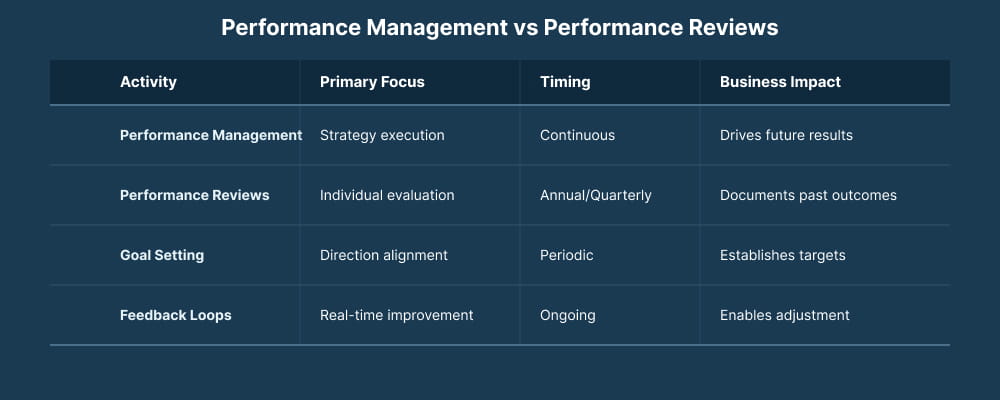
Performance management isnt the same as a Performance review, although they do connect.
A Performance review is an evaluation that is typically conducted either quarterly or annually, and is used to assess past performance.
It acts as a retrospective snapshot, documenting what has already happened.
These formal reviews usually serve as a benchmark for compensation decisions, development, promotions, and finding any weak spots that might need to be worked on.
However, they don’t drive that daily execution that makes teams great.
If anything, a performance review is the result of a good performance management plan in place, which again, drives daily, weekly, and monthly workflow.
Organizations that get these two mixed up end up with goals that are set and then put on a shelf somewhere and forgotten about until the year-end reviews.
They set goals in January, forget about them for the rest of the year, and then look at them during the year-end reviews. It’s too late at that point to do anything about performance.
Good performance management means that your goals are a living document. You’re checking on them on a regular basis, whether that’s once a week or once a month. Things come up and you’re able to deal with them in a timely manner.
Performance management systems that actually work share five essential components:
Goals aren’t going to mean much if they arent able to be translated into specific or measurable objectives at each and every level of the organization. The executive team's revenue growth target should flow straight into sales quotas, marketing lead goals, product development timelines, operation plans, etc.
When everything flows from the top down, it ensures that priorities are consistent across the company. A worse mistake to make here is setting too many priorities or conflicting priorities.
When everything is on fire, then everyone is looking just to exit the building. i.e., When everything is TOP Priority, nothing really is.
The best thing to do as an organization is limit focus to 3-5 strategic priorities and ensure every team can explain how their objectives support those priorities.
Some metrics are different then others.
Not all metrics are created equal.
The story told by leading indicators and lagging indicators is different in each case. While lagging indicators, such as last quarter’s revenue, show what has already occurred, leading indicators, such as the rate of the sales pipeline or the current trends of customer engagement, point to what is coming down the road.
The best performance management processes balance both. They track enough lagging indicators to understand what is really happening and enough leading indicators to predict what will happen in the future.
3. Feedback Loops
Quarterly business reviews are too slow. By the time you notice a problem during your Q3 business review, you've already lost half of Q4. Winners develop a weekly or bi-weekly cadence in which they operate, where they discuss, analyze, and address issues.
It doesn't mean meetings for the sake of meetings. It means focused meetings where the metrics that matter are addressed.
"We need to improve customer satisfaction" is a strategic aspiration.
"The VP of Customer Success will increase NPS from 42 to 55 by Q4 through implementation of the new onboarding program" is an example of accountability.
Now, you have a measurable, actionable goal that employees can meet.
Think of using SMART Goals to provide leadership and employees with specific, measurable, achievable, realistic and timely performance goals.
Knowing who is responsible for each outcome, how success is measured, and what happens when goals are not met is what helps aspirations become execution plans.
The rhythm of communication is as important as the message itself. Weekly operational reviews, monthly business reviews, or strategic updates on a quarterly basis—however you do it, the more consistent you are, the more discipline you will develop as a leader. You will understand what to expect, what information to bring, and when decisions will be made—predictably, rather than reactively.
Even well-designed systems hit predictable obstacles. Recognizing these patterns helps you avoid them:
Marketing wants to maximize lead generation, but sales wants to maximize lead quality. Product wants to build new features, and customer success wants to fix implementation problems. If you don't align goals between teams, you're just spinning your wheels.
The problem of having 28 metrics and not knowing what any one of them means. You can't make decisions because you don't know what to do. Good systems have around 5-7 key metrics that actually help you make decisions.
If you wait until you miss your revenue targets, you've already lost the quarter. You need to be able to predict your performance and get ahead. There is a great case here for ensuring you are constantly updating your company Financial Projections.
A Fractional CFO is of great advantage to growing companies. They can help track past performance and make educated predictive projections about future growth.
If you set annual goals and quarterly reviews, you're essentially saying you want to wait until you're two to three months into a quarter to get feedback. Well, you're not going to change course at that point. All you're going to do is try to figure out why you didn't hit your goals.
If your incentives are not aligned with your goals, your people will do what they think will get them rewarded, not what you want them to do. Compensation structure trumps strategy. Bonuses and commisions over base comp are great strategies to get employees motivated towards success.
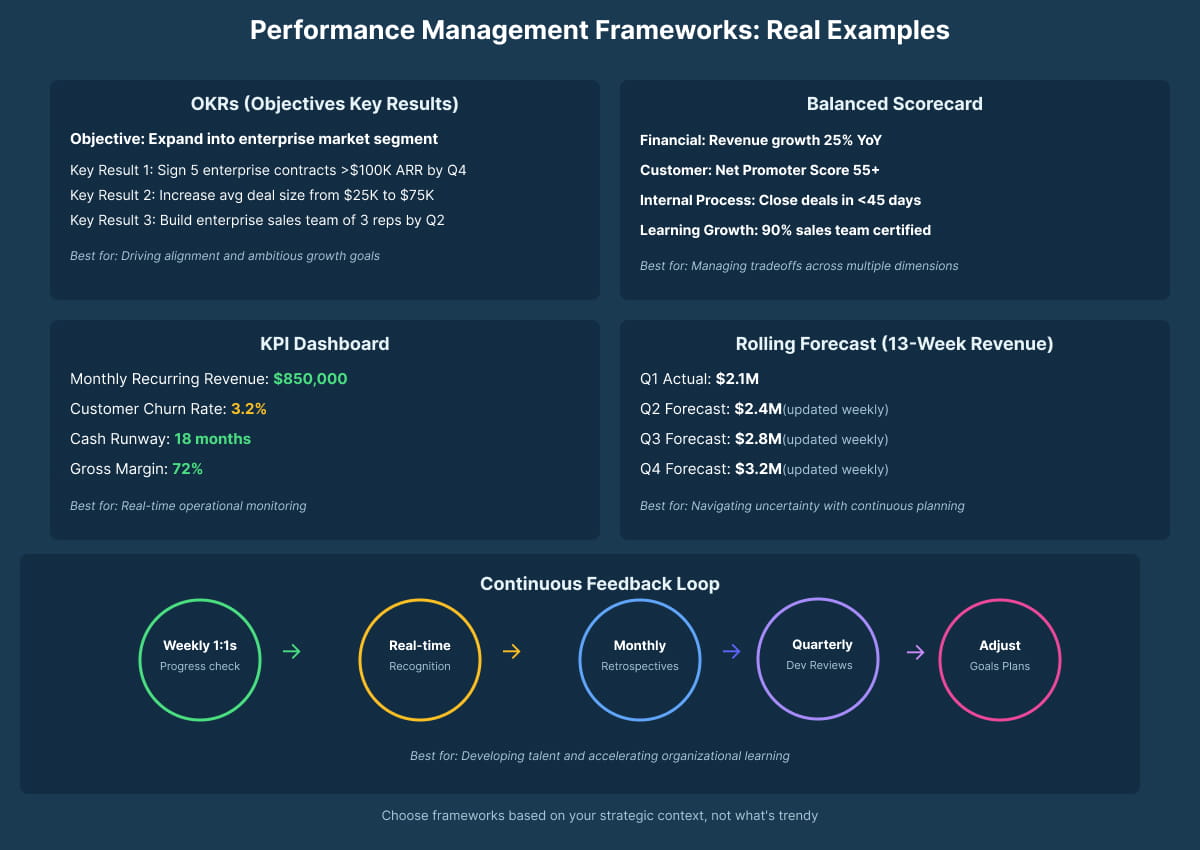
Different situations call for different frameworks. The key is matching the approach to your organizational context:
can be used when you have a need for organizational alignment on ambitious goals. The goal gives you direction, and the key results provide you with a way to measure success. This is particularly useful for a fast-growing organization where priorities are constantly in flux.
can be useful if you're managing conflicting demands—inherent tensions between growth and profitability, quality and speed, innovation and efficiency. By measuring performance on multiple measures (financial, customer, internal processes, learning, and growth), you can avoid the pitfall of maximizing one area at the expense of another.
serve operational leaders who need real-time visibility into business performance. The danger is creating dashboards that track everything but inform nothing. The best dashboards highlight the 5-7 metrics that actually drive decisions and flag exceptions that require attention.
replace static annual budgets with continuous planning horizons. Instead of locking into a January budget and watching it become obsolete by March, you maintain a 12-18 month forward view that updates monthly. This matters increasingly in volatile environments where annual planning is fiction. Pro Tip: Think about how your business can leverage AI for better forecasting
move beyond annual reviews to regular coaching conversations, real-time recognition, and rapid course correction. This approach accelerates capability development and keeps teams aligned as conditions change.
The sophistication required scales with organizational complexity. A 50-person company doesn't need the same performance infrastructure as a 5,000-person enterprise. Start simple, then add structure as coordination challenges grow.
There’s a time in every business when certain inflection points demand rethinking your overall performance management infrastructure.
Think about during the following:
When the growth of the company accelerates, the complexity of coordination explodes. What worked when the company had 20 people who managed themselves in an ad-hoc way will not work when the company has 100 people across multiple departments.
What needs to change:
A new CEO or a major shift in strategy can mean that your current goals and metrics are completely irrelevant. The goals that your old leadership team obsessed over may be meaningless to your new leadership team.
What needs to change:
Pro Tip : An Interim CFO who is brought in during a time of transition can be a big help to smooth over the chaos of a new strategic direction being implemented.
They arrive with no political capital to lose with the old regime, so they're free to make the difficult decisions about which sacred cows to sacrifice and which new ones to create.
They've been through this process many times before, so they know how to quickly redesign the performance infrastructure without disrupting the business or demoralizing the team still loyal to the old way of doing things.
The reality is, when you consistently miss your numbers quarter after quarter, you have a measurement problem or an execution problem. Either your goals are unrealistic, your approach is not working, or your measurement is completely wrong.
What needs to change:
Mergers, acquisitions, and organizational restructuring scramble accountability boundaries. Who owns what suddenly becomes unclear, goals get misaligned, and performance tracking systems don't map to the new org structure.
What needs to change:
In a disrupted market, the traditional metrics you use to predict success are meaningless. All the leading indicators you thought you knew, all the metrics you thought would predict success, are now useless to you because the underlying market dynamics have all changed.
What needs to change:
Growth can break systems.
What works when you're at $10M in revenue won't work when you're trying to get to $50M.
The informal processes that allowed your founding team to stay aligned will be chaos when you're trying to manage 15 functional leaders spread out over many different locations.
New leaders have new priorities.
The goals that were important to your old CEO may not be important to your new leader. If your performance management system still measures the old goals, you've created a state of confusion for your organization, where they don't know what's really important anymore.
If you're not meeting your goals, it's almost always a measurement issue, not an execution issue. It's either that you're measuring the wrong things, you're setting goals that you know you'll never meet without understanding the operational constraints, or you're not providing enough feedback to know when you're not meeting your goals.
Most organizations don't know their performance management system is broken until something forces them to confront the reality. It might be a board member asking you why you can't tell them what's really driving your business. It might be the third straight quarter you've missed your targets. It might be a new CFO who actually believes in data-driven decision-making.
The truth is, creating an effective performance management process takes expertise most organizations don’t have in-house.
You have a controller who knows how to close the books. You have an FP&A analyst who can create a forecast model. But creating an infrastructure that connects strategy to execution, figuring out which metrics really predict performance, and creating a governance process that keeps an organization focused? That takes strategic expertise at the CFO level.
The Organizations that plan the best typically have or bring in experienced financial leadership who have experience applying performance management in many companies across multiple growth stages.
That means, they have seen what works…. And what fails.
They know how to match a performance framework to organizational maturity, culture, and values.
This is precisely where a fractional CFO can have a disproportionate impact.
It's the ability to get a level of expertise at an executive level without the cost of an actual member of the C-suite. It's a person who can develop your OKR system, create your KPI dashboard, develop your governance structure, and educate your team on how to actually utilize these tools to drive better business decisions.
Organizations that get performance management thinking right don't simply survive a market downturn; they're able to capitalize on new opportunities when their competition is still trying to figure out what's happening.
They're able to make faster decisions with better information. They're able to identify issues early when they're still solvable. They're able to allocate resources to the things that are working instead of those with the most political capital.
But here's the thing: they're able to sleep better at night knowing their organization is executing to a plan instead of simply hoping things will somehow work out.
Are you ready to transform performance management from an aspiration to an execution advantage?
Let's talk about how McCracken Alliance can help you build performance infrastructure that connects strategy to results—and actually gets used to make better decisions.
The objective of performance management is to ensure that organizational strategies result in performance by providing clear organizational goals, accountability systems, and continuous feedback loops for course correction.
Performance management is a continuous process for driving execution. Performance reviews are a periodic process for assessing past individual performance. One drives performance; the other measures it.
Leading organizations review their operational performance on a weekly basis, business performance on a monthly basis, and strategic performance on a quarterly basis.


.svg)

.svg)