
Discover how brand recognition impacts CAC, pricing power, and enterprise value—and why it belongs in every CFO's growth strategy.
Discover how brand recognition impacts CAC, pricing power, and enterprise value—and why it belongs in every CFO's growth strategy.


Two competing software companies have similar products, similar sales teams, and the same target market.
One closes its deal in 45 days, and the other averages 90.
The first is able to convert to 23% qualified leads, while the second manages around 12%.
They have the same end buyer, and they're solving the same problem with their software service.
So what's the difference?
One is recognized and therefore trusted, and the other is just present.
This recognition, this engagement, this trust is not just a marketing story.
It becomes a story of unit economics, and it belongs squarely in every executive conversation regarding growth, capital allocation, and valuation up to the top.
So what’s so important in all this?
Brand recognition.
Brand recognition is the ability of a buyer to correctly identify your company, product, or logo when prompted.
The concept of brand recognition may appear simple at first glance, but it’s far from it. As an executive team racing to succeed in today’s competitive business landscape, brand recognition represents one of the most powerful and underrated levers in the financial model.
It reduces sales cycles, lowers customer acquisition costs, and increases pricing power. And if you’re evaluating M&A or private equity exits, it’s another way to move the needle on valuation.
This isn’t a marketing guide. It’s a financial guide for executives who want to understand how brand recognition really affects the income statement and balance sheet.
These terms get used interchangeably. They shouldn't.
Recognition is prompted. Recall is unprompted. Awareness is the umbrella.
The difference is huge in B2B/enterprise markets because buying groups almost never make decisions based on recall alone.
They put out RFPs, conduct competitive procurements, and then narrow the field to a shortlist of preferred providers. If a firm has high recognition levels, it gets on that shortlist faster, can get through the buying process more easily, and minimizes "who are these guys?" questions at the highest levels of the organization. This drives direct benefits to sales cycles and the cost of closed deals.
For growth strategies tied to private equity investments or roll-ups of existing brands, the level of recognition at the platform level drives how efficiently the newly acquired brands can cross-sell into existing customer bases.
Don't make the mistake of ignoring the difference between the two and pouring resources into awareness metrics that won't drive conversion rates.
Let's get specific about what recognition actually does to the financial model.
If the customer already knows who you are, you spend less time convincing them that you’re credible. Marketing teams require fewer touchpoints to move them through awareness to consideration. The sales process shortens. Fewer resources are required to close a deal. The math on CAC improves without increasing headcount or ad spend.
Being a recognized brand means you don't have to offer discounts as often. If the prospect has heard of you through industry conversations, seen your executives named in relevant publications, or worked with another company in their network that has given you a strong recommendation, they’re going to start with a certain level of trust. That trust is worth real margin points. How brand recognition supports sustainable market share growth isn't abstract: it's the difference between defending price and caving on it.
In many enterprise B2Bs, the first two stages of a buying cycle, coined awareness and consideration, can consume weeks or months of work. A recognized brand will help compress both. Buyers are able to skip credibility-building conversations, because, well, they already know and trust your brand. This means they can move way faster into evaluation. And all that velocity? It has a direct dollar value when calculating the loaded cost of your sales team's time.
Investors will always have a built-in risk premium when it comes to businesses that they’ve never heard of. A recognizable brand can signal market validation, customer stability, and revenue predictability. Those signals are able to reduce risk and perceived risk multiples.
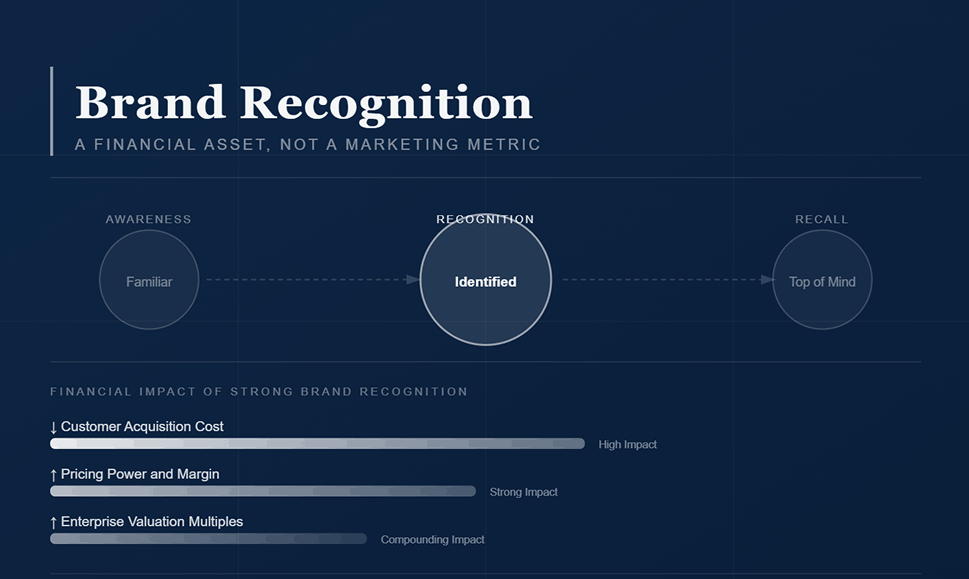
This is where the discussion typically ends for marketers, but a CFO should not be satisfied with this level of discussion because there is a clear connection to income statement items that can be quantified.
1.Revenue Growth Correlation.
Recognized brands will typically have a larger inbound pipeline, which means more leads that know who you are. Inbound leads convert at a much higher rate than outbound leads, and the compounding effect on revenue over a few quarters can be quantified.
2.Marketing Efficiency Ratios.
Measure your cost per qualified lead over time as recognition grows. If the recognition investments you've made are successful, you'll see this number change, not because you've reduced spend, but because you've become more efficient.
3.EBITDA Margin Resilience.
Recognized brands tend to perform better during a recession because, during a recession, customers will reduce spend on unfamiliar vendors. A recognized brand provides a level of risk reduction for a purchasing organization that has to defend their vendor spend to their CFO. You become the safe choice, not the first to be eliminated.
4.Capital market implications.
This one gets overlooked. Weighted average cost of capital is influenced by how capital markets perceive risk in your business. A company with clear brand positioning, consistent revenue narratives, and strong market presence signals predictability. Predictability lowers the risk premium lenders and investors apply. That's not a soft benefit — it directly affects the cost of growth capital.
Executives want metrics. Fair. Here's what actually matters.
Quantitative brand measures:
Financial correlates to watch:
For growth-stage companies, these metrics sit alongside other growth-stage performance metrics that executive teams should be tracking quarterly. Brand recognition metrics shouldn't live in a separate marketing dashboard — they belong in the operating review alongside CAC, LTV, and payback period.
Consumer brand recognition is based on repetition and breadth. In contrast, with B2B, it’s more complex, more unforgiving, and more nuanced.
In enterprise, there are procurement, legal, finance, IT, and end user groups. Each group has its own filter. Finance wants to make sure you’ll still be around in three years. Procurement wants to make sure you’re a known entity with references. And the end user wants to make sure you solved it for someone they admire.
Thought leadership is the B2B recognition engine. When your executives are named in industry publications, when your white papers appear in due diligence, when your company is mentioned in conversations between peers of enterprise buyers, that’s recognition working at the deepest level of enterprise decision-making.
Strategic partners can also amplify brand recognition. When you’re associated with another brand that’s trusted by the buyer, by the ecosystem, that’s another way to increase recognition. And it’s no accident that the most recognized B2B brands are also the ones that make significant investments in their ecosystems.
Here's where things get particularly relevant for PE-backed businesses.
In roll-up strategies, brand consolidation is one of the most consequential post-acquisition decisions a management team makes. Keep individual brands, and you fragment recognition across the market. Build toward a platform brand, and you concentrate equity — but only if the platform brand carries enough weight to absorb the acquired names without losing their existing customer trust.
Pre-exit, brand recognition directly influences revenue quality perception. Acquirers discount revenue that feels fragile. If your customer base is loyal to individual salespeople rather than the company itself, churn risk is priced into the deal. A recognized brand creates stickiness that isn't dependent on any single relationship — and buyers pay for that stability.
Leveraged buyout structures are particularly sensitive to revenue predictability assumptions. A business that can demonstrate brand-driven inbound demand — rather than pure outbound sales dependence — presents a fundamentally different risk profile to a financial buyer.
It’s best to consider hiring an M&A consultant if you think that your brand might need a bit of help with its valuation or recognition level during any divestments or other situations.
Multiple expansion strategy, in practical terms, often comes down to this: can the business grow without proportional increases in sales and marketing spend? Brand recognition is the mechanism that makes that possible.
Let's face it: most of the advice you read about "brand building" sounds like it was written by a focus group of people who have never actually sold anything. So, what does actually work, without all the hype?
Recognition without positioning is just noise with a logo. Before you spend a dime on increasing your recognition, you need to know precisely who you serve, what you do better than the competition, and what you believe that makes you different. Consumers do not remember brands that are everything to everybody. They remember brands that are like them.
This is something that the best B2B brands figured out a long, long time ago: consumers trust people before they trust companies. When your CFO is quoted in industry publications, when your CEO is on a panel at an industry conference that your consumers actually attend, when your executives' LinkedIn posts are being shared by the consumers you're trying to reach, that's brand recognition working behind the scenes before your sales team ever makes a call.
Not blog posts. Not newsletter filler. Frameworks, analyses, and proprietary perspectives that buyers print out, share across Slack channels, and take into their own board meetings. That's the content that gets recognition – because it's actually useful, not just Google-indexed. Anyone can create content that gets scrolled past. Anyone can create content that gets remembered. There's a world of difference between the two.
This one requires a little financial discipline – a little ironic, given the audience. Brand recognition is a compound asset – slowly at first, then quickly. The problem is that the growth curve conflicts terribly with the 90-day budget review cycle. That's why the executive team always underspends on it – because there's no connection between the short-term pain of cutting the budget now versus the long-term effects of rising Customer Acquisition Costs 18 months later, pipeline conversion slowing down, and nobody realizing that the two are connected. Brand spend is not just a budget line item – it's a long-term asset that deserves the same long-term thinking that goes into every other capital allocation decision.
Campaigns have finite ends. The concept of brand recognition is cumulative. Organizations that start and stop investment in brand based on short-term budget cycles reset the compounding clock every time.
Impressions are low-cost. Influence – the kind that shows up in sales conversations, competitor evaluations, and referral behavior – is what you're actually trying to buy.
Nothing hurts brand equity more than confusing the market. M&A brand integration needs a thoughtful strategy – not an afterthought.
If brand investment cannot be tied to CAC acceleration, conversion rate changes, or margin stability, then it becomes a line item to cut. Build the measurement framework before the investment – not after.
In accounting terms, a brand value appears on a balance sheet as an item called "goodwill." It's only visible after an acquisition, but its existence precedes that by a long time.
Brand recognition is a form of reputation capital that makes every business transaction easier by reducing costs, including acquiring new customers, dealing with vendors, recruiting employees, and providing a predictable stream of revenues that sophisticated acquirers and investors factor into their financial models.
The debate over whether brand recognition has real value is over; it clearly does. The debate should be over whether your management team is measuring, managing, and investing accordingly, or treating it as discretionary spending that vanishes with a tightened budget co
So, let's strip away all that technical complexity and really think about what's important.
The financial impact is anything but theoretical, by the way, because:
More investor confidence means better access to capital on better terms.
The three areas companies struggle with time and again:
#1 Measurement gap: Brand investment occurs, but there's no financial model that links that investment to CAC, conversion rate, or margin achievement. It's stuck in the marketing bucket.
#2 Time horizon mismatch: Brand recognition is a compound effect over 12-36 months, while financial planning cycles reward achievement over a 90-day horizon.
#3 Organizational disconnect: Marketing owns brand, finance owns metrics, but nobody owns the intersection, which is where the value leaks out.
This is exactly where experienced financial leadership changes the outcome. Whether through fractional CFO partnership to build the measurement framework, interim CFO support during a critical growth or pre-exit phase, or leadership development that builds your team's financial fluency — the right expertise connects brand decisions to business outcomes in a language the entire executive team can act on.
Companies that master brand recognition as a financial discipline don't just build better marketing. They build businesses that are easier to grow, harder to displace, and more valuable to acquire.
Ready to connect your brand strategy to the financial metrics that actually matter?
The gap between a recognized brand and a visible one often comes down to having the right financial infrastructure to measure and manage the difference. Let's talk about how we can help you build it.
Brand recognition is the capacity of a possible customer to recognize your company, product, or logo when given cues, as opposed to when they recall it on their own. In business, it is used to determine the pace at which buyers go through the sales process and the amount of trust you have going into the evaluation process.
Brand recognition is an intangible asset used by business executives, which means it has significant financial implications, as opposed to being used as a marketing metric to be monitored.
Quantitative measures include aided recognition surveys, branded keyword search trends, share of voice analysis, and direct traffic growth. The financial correlates of CAC trends, conversion rate movements, discount frequency, and LTV by cohort link the brand investment back to business outcomes.
Recognition is seeing your logo or name and knowing what it is. Recall is seeing your logo or name and not necessarily knowing what it is. Both are important metrics, but recognition is the first step – and the step that gets you on the shortlist for B2B enterprise buyers.


.svg)

.svg)