
A financial review is a leadership discipline. Learn how to evaluate performance, manage capital, and guide your company.
A financial review is a leadership discipline. Learn how to evaluate performance, manage capital, and guide your company.


Final numbers came in.
Revenue is up 12%, meeting quarterly goals, and the team is celebrating.
But hopefully they don’t go crack open those cold ones and order a nice dinner quite yet.
Just then, someone calls out, “Did anyone run the balance sheet?” (Of course, it had to be Dan from accounting)
**Crickets***
While this scenario seems a bit presumptuous and story-like, the point is that checking revenue numbers is not just enough to evaluate financial performance.
Are you ALSO checking :
The pitfall that even seasoned veterans of financial management often fall prey to:fusing revenue growth with overall financial health.
A strong income statement can mask a failing balance sheet, a profitable quarter can precede a financial crisis, and by the time the signs are unmistakable, it’s already too late to take corrective action.
And that’s exactly what a financial review is designed to prevent.
Done well, a financial review isn’t just an exercise in retroactive compliance; it’s a dynamic process of operating a business that prioritizes financial decisions based on hard numbers before crises develop.
In the following pages, you’ll learn exactly what a financial review entails, best practices for conducting a financial review, and why organizations that take financial reviews seriously are consistently ahead of those that don’t.
(And why you don’t ever have to be let down by Dan from accounting again )
Financial check has a lot of sources of information that it pulls in from your company’s numbers setup. At the end of the day, it typically looks at:
It may be done by a finance team, it may be done by a CPA firm, and it may be a management review or a review by someone outside of the company.
When it’s a review by someone outside of the company, it’s a limited assurance engagement, which means it’s harder than a compilation engagement, which means it’s not as hard as an audit.
For most growing companies, the most important part of the whole process is the internal management review, and it’s what keeps the company in line and what keeps the company’s strategy grounded in reality.
PRO TIP : Many growing companies find that they benefit greatly from bringing on Fractional or Interim financial help through the use of a CFO who can work on a part-time or on-demand basis and deliver CFO-level financial discipline without the cost of a full-time hire.
Financial Review vs. Audit: What's the Difference?
These terms get conflated constantly, and the confusion carries real consequences — particularly when boards, lenders, or investors ask for financial assurance.
Let’s compare and contrast the two for a clearer picture below:
No.
A review gives limited assurance that everything seems okay and that nothing material seems misstated on the face of the financials.
An audit gives reasonable assurance through substantive testing and verification. Reviews are often required by private companies and lenders as a middle ground between internal reporting and the audit requirement.
If you are unsure what your lender requires, review the covenant language. "Review" and "audit" are not synonymous in a credit agreement.
The Financial Review Process Step-by-Step
Running a financial review without a structured process produces inconsistent results. Here's how disciplined finance teams approach it.
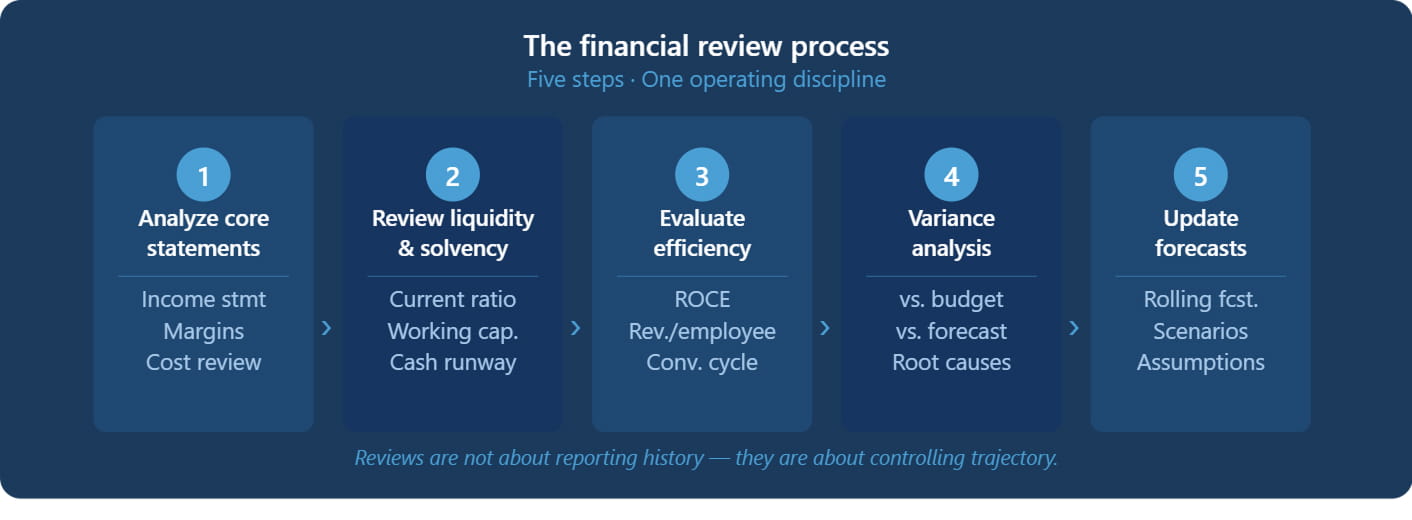
Start with the income statement, not just the numbers, but also the trends.
Is the gross margin holding its own? Where are costs growing faster than revenue? Is the revenue growth pattern changing in a way that erodes margin, even if revenue growth is strong? Mastering the income statement goes beyond just net income. You want to get a sense of the story behind the numbers, which products contribute to margin expansion, which contribute to margin compression, and whether cost structure changes are permanent or cyclical.
And finally, the balance sheet. Asset quality, accounts receivable, and equity position tell you if the company is creating or destroying value, something the income statement cannot tell you.
Liquidity analysis is used to answer one fundamental question: Can this business pay its bills in the short term without freaking out?
The relevant data points are the current ratio, quick ratio, and working capital position. However, don’t just stop at the ratios.
Make an explicit statement about the cash position:
This is where the financial review directly relates to the actual running of the business. Return on capital employed is a measure of the company’s ability to make a profit from the capital it employs.
Revenue per employee is a comparison of the company’s productive employees to the industry’s.
Cash conversion cycle is a description of the speed at which the company generates cash.
These aren’t vanity metrics. These metrics relate directly to decisions about where to put capital, what to price, and who to hire.
Variance analysis is where a lot of financial reviews lose their discipline.
The point of variance analysis isn’t to understand all variances, big or small.
The point is to understand what variances are structural (the business has changed) and what variances are temporary.
Calling a structural variance temporary is one of the most expensive mistakes an executive leadership can make.
Variance in revenues due to volume vs. variance in revenues due to price requires totally different strategic actions.
A financial review that doesn't update the forward model is only half the process.
A rolling forecast utilizes current performance data, effectively replacing static annual budgets with "living, breathing" financial models.
Scenario planning helps us validate our assumptions against a range of downside, base, and upside scenarios. And sensitivity analysis identifies which factors have the greatest impact, helping senior management focus in on what really matters.
The one question to ask in every review: Do current assumptions still hold?
Frequency should match the pace of change in the business and the decisions leadership needs to make.

Tactical in focus.
Department-level KPIs, cash flow monitoring, and operational performance. This process would be relevant to any company where the cash management process is an active process, or where the business is in a high-growth or high-risk phase.
The intended audience would be the internal leadership team.
Strategic recalibration.
This process is where capital allocation decisions are made, board reporting is generated, and performance evaluation occurs relative to annual targets. The quarterly process would include the entire five-step process as described above. Outputs from this process would be relevant to board and investor reporting.
Long-term capital planning.
The annual process would involve the evaluation of the entire year's performance, including the evaluation of the WACC and its implications for strategic investments. This process would also involve the evaluation of whether the capital structure of the business is appropriate, relative to the growth targets.
Every financial review should track, at minimum:
Industry-specific metrics will vary, but any review that skips cash flow, margin, and capital efficiency metrics is leaving the most important levers unexamined.
Here's the framing shift that separates companies with strong financial governance from those perpetually reacting to surprises.
A financial review is the control center of the Office of the CFO.
It's the place where financial leadership turns data into decisions.
When done well, it enhances boardroom communications. Boards make better decisions when they have clear, contextualized financial information rather than just data.
It builds investor confidence because it sends a message that the management team is able to spot problems early.
It avoids cash crises.
Most cash crises aren't caused by sudden changes. Instead, they're caused by early warning signs that were never reviewed in time. It allows for disciplined growth because it ensures that capital is deployed according to strategy, rather than according to instinct.
The reality is that executives who don't have a structured financial review process in place are flying an aircraft without instruments. They're making capital allocation decisions, hiring decisions, and pricing decisions based on instinct and memory, rather than data.
For companies that haven't institutionalized this discipline internally, fractional CFO services provide the financial leadership framework to build and run effective reviews — without the overhead of a full-time hire.
Even experienced teams make these consistently. Its good to be aware:
1.Reviewing numbers without context.
A 15% revenue decline may have a completely different implication for a business that is intentionally changing its position versus a business losing share to a competitor. Decisions made without direction are decisions made blindly.
2.Focusing exclusively on revenue.
Revenue growth is tempting, especially for growth-stage businesses. However, revenue growth combined with declining margins, increasing receivables, and rising debt is not growth; it's risk accumulation.
3.Ignoring balance sheet health.
Income statements may get all the glamour. Balance sheets expose the underlying structural reality. Many businesses may have been profitable on paper and still gone out of business because their underlying balance sheet reality was quietly getting worse.
4.Failing to update assumptions.
A forecast made on January assumptions and used to make decisions in September is not a forecast; it's a liability. Updating forecasts is a requirement for businesses in a changing world.
5.Treating reviews as compliance exercises.
This is the most common and most costly mistake. When financial reviews become checkbox activities rather than decision-making forums, the data gets reviewed but never acted on — and the entire value evaporates.
The businesses that get the most out of financial reviews do only one thing differently. They close the loop between what the review tells them, what the numbers tell them, and what the business actually does.
If a review shows a product line is using too much working capital for the margin it’s producing, that should trigger a discussion about capital reallocation. It shouldn’t be a line in the board deck.
If the review shows KPIs that actually matter, they should be connected to how people get rewarded. Having the incentives line up with what the review shows is a hallmark of good financial management.
If a margin squeeze is what the review shows, that should trigger a discussion about pricing discipline. Sometimes the financial review provides the evidence for a discussion about pricing that might otherwise never take place.
If the operating margin goes down because of a change in the cost structure, that’s a different answer than if it goes down because of a change in the revenue mix. Reviews that connect the dots so you understand the root cause of the issue let you make the right moves rather than hacking away at costs.
Financial reviews aren’t about bragging about the past. They’re about directing the future.
Let's set aside the framework for a moment and look at things in the light of day.
Financial review isn't a document your accountant produces once a quarter.
It's the recurring discipline that determines whether your leadership team is actually managing the business — or just reacting to it. Understanding your income statement trends, capital efficiency, and liquidity position isn't CFO-level luxury.
It's the baseline for informed executive decision-making.
You know financial reviews matter. The harder question is why so many companies don't run them well.
We see it all the time.
Reviews that only talk about revenue. Boards that receive financial packages but never look at the balance sheet.
Management teams that never update their forecast from January to December.
Growth companies that talk about their top-line growth, but never address their working capital.
The problem isn’t that people don’t understand the issue. The problem is the setup. To do a real, honest financial review, you need steady data, a framework of the right metrics, someone who understands the difference between structural and temporary changes, and a process that converts the results into action. Most companies don’t have all four.
The companies we work with tend to face three major challenges:
1.Capacity: Internal finance teams are stretched covering reporting and compliance. Building a structured review process on top of core accounting functions requires bandwidth that simply doesn't exist.
2.Expertise: Variance analysis, scenario planning, and capital efficiency evaluation require skills that go beyond standard accounting. Many growing businesses don't have a CFO-level analytical capability internally.
3.Accountability: Without someone whose job it is to drive the review process and challenge assumptions, reviews get deprioritized when business pressure mounts — exactly when they're most needed.
This is where experienced financial leadership transforms how organizations operate. Whether through interim CFO support during critical growth or transition phases, fractional CFO partnership for ongoing financial governance, or finance team development that builds internal review capability, the right guidance doesn't just produce better reports — it builds the financial discipline that compounds over time.
Businesses that adopt a strict process for reviewing their finances not only identify issues earlier, but they also make more informed decisions about how to allocate their money, communicate more persuasively to their boards and investors, and cultivate a level of financial situational awareness that drives growth.
The businesses that get this right sleep well at night because their major decisions aren’t made on assumptions, but rather on facts.
Ready to build a financial review process that actually drives decisions?
The difference between companies that use financial reviews as strategic tools and those that treat them as reporting obligations often comes down to having the right financial leadership at the right moment.
Let's talk about how to close that gap.
This is a review of the income statement, the balance sheet, and the cash flow statement, as well as tracking KPIs, comparing actuals to budget and prior periods, and providing a forward-looking update of the forecast and assumptions. This review may be performed by internal management or an outside CPA company, depending upon the intended reader and usage of the review.
Financial review provides you with limited reassurance, mostly through quick analysis and questioning. An audit provides stronger reassurance through lots of testing, sampling, and independent verification. Reviews are less costly, less intrusive, and best suited for most private enterprises and lender reporting needs. Audits are necessary for public enterprises and when regulations or loan covenants require them.
Most companies have monthly check-ins on cash flows and ops KPIs, quarterly ones on strategic tweaks and board updates, and yearly ones on long-term capital planning and valuation checks. Fast-growing companies, especially, might need more frequent ones based on the rate at which the company is changing.
Internal reviews are usually performed by the CFO or VP of Finance. External reviews are performed by CPA firms. If a company does not have a dedicated finance leader, they often bring in fractional or interim CFOs to establish and conduct the review process—giving you the benefits of a CFO-level discipline without the full-time cost.


.svg)

.svg)