


When was the last time you bought something?
How was your experience?
Easy?
Freeing?
Arduous?
Confusing?
Frustrating?
Exhilarating?
Relaxing?
When is the last time you experienced the following :
You discovered a solution at exactly the right moment, the sales conversation actually addressed your concerns, onboarding made sense, and six months later, you're still glad you made the purchase. Everything just... worked.
Think about how different that is from the nightmare scenarios.
The product demo promised features that don't exist.
The sales rep who disappeared after you signed.
The implementation team had no idea what you were sold.
The Amazon order that led to endless regrets…
No matter how difficult or how simple, whether for business or for pleasure, here's what separates those two experiences:
Someone mapped the journey and gave a damn about what happens at every stage.
And they probably used a customer journey map to design your experience.
Without one? Your customers might feel like they're lost in the woods of confusion and frustration, and while your product or service could be top-notch, they might leave that path less than satisfied.
A Customer Journey Map is a visual representation of every interaction a customer has with your business.
It outlines the Entire customer Journey from:
At Each Stage, taking stock of:
Think of a customer journey map like a strategic blueprint for how customers move through your business.
It's not just something ‘marketing does’ in their spare time. The map truly is a cross-functional framework that can reveal where you’re winning customers, where you're losing them, and what it all COSTS.
Each stage often has its own touchpoints, may it be emails, sales calls, product type demos, support, billing experience, and more. Each touchpoint carries emotional weight for the customer and financial weight for your business.
What makes the difference between a truly effective customer journey map to one that just looks pretty is their actual connection to business outcomes.
Strong journey maps do more than chart steps-they quantify the impact. They answer key questions like :
The customer experience journey map/CX journey map and the user journey map are essentially the same instrument with a slightly different focus.
Whereas customer experience maps are typically concerned with emotional experiences and satisfaction, user journey maps, which are often used in a product development context, are more functional and usability-oriented.
The buyer journey map takes a close look at pre-purchase activities.
Regardless of specific terminology, however, the end purpose of all of these methods is the same: to better understand and then optimize customer experiences, as well as one’s own business performance.
Can we be honest?
Most companies think they understand their customer journey because they've got a sales funnel and some marketing automation.
That's not the same thing.
A sales funnel shows you where prospects drop off.
A customer journey map shows you why—and what you can do about it. It reveals friction points you didn't know existed.
It exposes disconnects between what marketing promises and what the product delivers. It highlights the post-purchase experience gaps that silently erode retention and torch your customer acquisition cost (CAC) payback assumptions.
Savvy companies view customer journey mapping as a vehicle for strategic planning, rather than just an operational process. They correlate journey steps with financial objectives and measures.
They understand that while enhancing their consideration step may involve improved content, it also entails reducing their sales cycles, reducing their cost per lead, and gaining speed in their cash conversion.
They also understand that their customer success efforts have a direct impact on their net revenue retention and their possible growth in expansion revenue.
If your customer journey map doesn't connect to your financial model, it's decorative.
You're missing the moments of truth that drive unit economics.
You're making decisions without understanding their P&L impact.
And you're probably investing resources in the wrong stages because you're optimizing for engagement metrics instead of business outcomes.
Customer journey mapping done right becomes the connective tissue between customer experience strategy and financial performance.
It ensures your business :
The customer journey typically has six core stages, although some organizations like B2B or service firms, may need to spruce things up a bit on longer sales cycles or multi-stakeholder decision processes.
.png)
1. Awareness Stage
The customer is first exposed to a problem or an opportunity and is introduced to your brand as a solution.
2. Consideration Stage
The customer actively evaluates options and compares solutions.
3. Decision Stage
The customer confirms the purchase.
4. Onboarding Stage
The post-purchase experience begins.
5. Retention Stage
The customer consumes your product or service.
6. Loyalty Stage
They become an absolute advocate.
Let’s look at the step-by-step process in which you can build your Custom Company Customer Journey Map, using a methodology that actually produces actionable results:
.png)
Step 1: Define Your Scope and Objectives
To begin, it’s essential to understand what you are mapping and why.
Including both experience objectives and business outcomes in your goals is important.
“Improve onboarding satisfaction” is not specific enough. “Reduce time-to-first-value from 45 days to 30 days, increasing 90-day retention by 15%” ties an experience metric to financial results.
Step 2: Gather Data from Multiple Sources
The shortcoming with customer journey mapping is that it is often based on presumptions about customers by the business.
It's so important to obtain quantitative data such as the transition rates among stages, average time spent on each stage, points where customers drop off, and customer support ticket and NPS scores at each point in their journey.
Here’s the key thing most companies get wrong: They map the intended journey, not the actual journey.
Your map should accurately represent the real world, including the workarounds consumers have devised, the pain points they accept, and the unofficial touchpoints they use to fill the gaps of your official process.
Step 3: Identify Touchpoints, Actions, and Emotions
At each and every stage, you should be documenting each touchpoint where a customer interacts with your business.
Start with the obvious ones :
And don’t forget the subtle ones :
At each, map the customers' actions and touchpoints (what they are doing), their thoughts (what they're trying to accomplish), and their emotions (how they're feeling).
With a three-tier approach, disconnects get revealed. For example, a customer might take the action you want (sign a contract) and think “Ugh, I hope we didn’t miss anything!” and be feeling super anxious. That emotional gap creates churn risk.
Solution? A little checklist was added to the back of the contract that puts them at ease so they can circle back on any issues. See how getting into your customer’s head can help you see all the flaws?
Step 4: Map Business Metrics to Journey Stages
This is where finance leaders should be actively involved, yet rarely are. For each stage, define the metrics that matter:
Without this step, your journey map is a CX exercise disconnected from business performance. With it, you've created a strategic planning tool.
Step 5: Identify Friction Points and Opportunities
Find moments of truth—those high-leverage points where much is at stake.
Those points of friction are your biggest opportunities.
Let’s be honest – you’ll find more problems than you can solve.
This should be in terms of financial impact, not just the rate of complaint. A problem that impacts 5% of customers yet reduces their lifetime value significantly will weigh differently than an annoyance that impacts 50% of customers but does not impact financial performance.
Step 6: Create the Visual Journey Map
Apply your analysis to a visual diagram using a customer journey map. It is not so much the exact form that is important, but that it is easy to understand.
You want to use ‘swim lanes’ to show the various stages, touchpoints, emotions, and metrics in your visual image. Identify where there are ‘valleys,’ or ‘friction points,’ along with ‘peaks,’ or ‘delight moments.’
.png)
Just remember that good customer journey maps are resources, and poor ones are presentation materials. Journey maps need to be granular enough for cross-functional planning, but not simplified to the point that they’re lost.
Step 7: Test, Iterate, and Update
Look, your first customer journey map is going to be wrong in some meaningful ways. That’s actually where the beauty happens. Being wrong about your customers means you have carved out the space to start to meet them.
As you test, iterate and update, and implement changes, your map will get better and better. It's all about gathering the right data, analyzing, updating your CS experience, and adding to the map.
You’ll create emerging touchpoints, customers will shift, competition will change, and all these dynamics will rock up your map. Treat your map as a living, breathing document, like a path your customer walks - new flowers pop up all the time.
B2B customer journey maps differ from consumer maps in complexity, cycle length, and stakeholder involvement. Here's what effective B2B journey mapping looks like in practice:
The company's decision phase was headed towards a 90-day average. Honestly, they realized it was not because consumers lacked commitment in their product, but bedcause there was so much necessary legal analysis, security testing, and procurement procedures.
Instead of fighting these delays, they were incorporated into the customer experience through touch points that kept the momentum going even while waiting:
"Dead time" became a useful time to form relationships to alleviate risks associated with the transition after purchase and build customers' confidence.
Clients who had not received contact from their engagement team in the first 72 hours after the contract signing exhibited 40% rates of early terminations.
Improved retention and faster revenue realization.
Customers in the SaaS company were unable to acquire key product features in the span of 60 days. The ones that had this problem had a lifetime value reduced by 60% in comparison to the customers who were able to.
The company revamped its onboarding experience to promote the adoption of these important features early on.
This resulted in an 18% increase in net revenue retention rate, as well as a reduction in time-to-value.
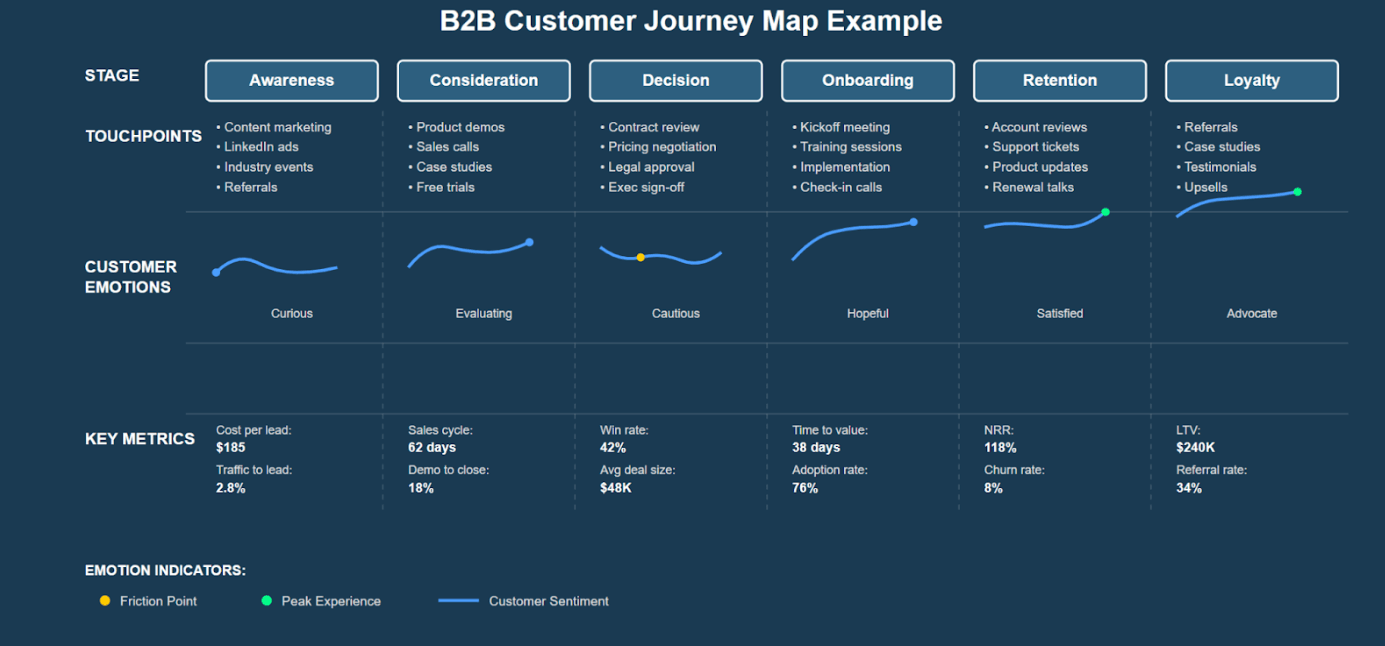
Not every customer journey map is made complete or correct. Many of them fail to drive meaningful change. They become slide decks that executives laugh at and nod at during quarterly reviews, and ignore after.
In this scenario, teams create the journey that they wish their customers could have instead of the one they really experience. It’s like catfishing for customers. This basically makes the map useless for identifying pain points or improvements. Mapping reality, the good, bad and ugly is the map you want to start with.
Organizations pursue awareness, consideration, and decision, but the stages of onboarding, retention, and loyalty are treated as an afterthought. It creates lost profit opportunities because the post-purchase stages are what ultimately determine profitability.
Customer journey maps are full of emoticons and quotes from customers but lack data points on conversion rates or costs. There is no way to determine importance or value without costs.
The customer journey does not just exist in marketing. So if they create the map themselves, you're going to wonder why sales, product, and support never use it. Effective mapping is a cross-functional, full org doc that should include shared input and shared ownership.
The teams spend weeks designing a perfect journey map, showing it to the management, and then never look at it again. The fact is that a customer journey is in a constant state of evolution, so should the map be.
Without the involvement and commitment at the C-level to implement the findings from the journey maps, it becomes a theoretical exercise. Effective journey mapping requires the power of change within functions, which calls for the involvement of the C-level.
The actual template that you choose to use for your customer journey map is far less important than the level of commitment that you make to keep it updated. Bearing that in mind, the key to an effective customer journey map likely includes:
Tools range from simple (collaborative whiteboards, spreadsheets) to sophisticated (dedicated customer journey mapping platforms like Smaply, UXPressia, or Miro templates).
Figma is a great tool to create a simple startup of a customer journey map.
The sophistication of your tool should match your organization's maturity. If you're creating your first journey map, start simple. If you're managing multiple customer segments and need version control and stakeholder collaboration, invest in purpose-built software.
Many organizations find the value in taking a generic example of the customer journey map from their industry of interest and adapting it to their situation. Just be sure not to get caught in the trap of copying the example without testing it for their customers.
The most difficult part of developing a customer journey map is not the actual creation of the map itself, but what you will learn and the action you will take from it.
You will realize the inefficiency of your own expenditures in the awareness stage relative to your lack of investment in your own referral programs.
You’ll see the inefficiency of your own onboarding process for people who don’t have the time and expertise they’re assuming.
These insights require organizational changes, resource reallocation, and cross-functional collaboration. That's where most companies stall. They've got the map, they know what needs fixing, but they lack the strategic oversight to drive execution.
This is precisely where the Fractional CFO or Interim CFO can provide tremendous value.
They are stuck exactly at the intersection of customer strategy and financial outcomes, taking insights gleaned from the journey map and developing models on how improvements can create a positive return.
They can help develop business cases to justify investment in optimizing the journeys, while ensuring the business remains obsessed with the metrics that matter most and is not misled by metrics that don't.
If you are looking for a leader to collaborate on the first journey mapping effort, a translation expert to apply CX knowledge to financial strategy, or someone to serve as a sounding board while you optimize each stage, McCracken Alliance offers you access to CFO professionals with knowledge of the CX and the unit economics required for success.
Because the truth is this: journey maps as PowerPoint slides do not enhance the process. Journey maps that are part of the strategic planning process, based on financial analysis data, and where improvement is continually pursued—those are the ones that will change the business.
What is a customer journey map?
A customer journey map is a tool that identifies all the interactions that a customer has with a business, from awareness to loyalty stages, and captures all the points that influence financial and business metrics along the way.
How do you create a customer journey map?
Starting with the definition of scope and objective,collect both qualitative and quantitative information about customers. Determine the touch points as well as the emotions involved in every step, align business metrics to the milestones in the journey, and identify areas of friction. Use the visual representation, which keeps honing in on new information.
What are the stages of a customer journey map?
The six underlying phases are: Awareness - where he comes across your company, Consideration - where he evaluates alternatives, Decision - where he decides to purchase, The onboarding phase - where he implements, The retention phase - where he continues using, or The loyalty phase - where he advocates. For B2B businesses, these phases need to be customized depending on the complexity.
Why is customer journey mapping important?
The six key stages are awareness, which begins when a customer finds your brand; consideration, which begins when options are evaluated; decision, when a commitment to buy is made; onboarding, or implementation and starting use; retention, which centers on use and renewal sales; and then loyalty, when expansion enters into play. B2B companies can also customize these stages based on sales cycles, which are longer in B2B sales cycles than B2C sales cycles.
What's the difference between a sales funnel and a customer journey map?
A sales funnel shows where prospects drop off during the purchase process. A customer journey map reveals why they drop off, what happens after purchase, and how customer experience impacts financial outcomes across the entire lifecycle—not just the pre-sale stages.


.svg)

.svg)