


Accounting and finance- these terms are thrown around almost interchangeably sometimes.
Although they could be seen as two sides of the same coin, they’re certainly not the same.
Why?
Picture this: two people at a company dinner
One has memorized and broken down every single line item on the bill. Including who owes what with a tip breakdown, and a receipt photographed and filled out before the check even hit the table.
The other one is already sketching out whether the company should even do this dinner. And if so, should it be quarterly or monthly, expensed differently, and also what the ROI looks like if client entertainment spend goes up 15%.
Same dinner, same receipt, wildly different thought process.
That's accounting and finance in a nutshell- best friends, same language, completely different jobs.
And for business leaders who treat them as interchangeable? That misunderstanding shows up in poor forecasting, compliance headaches, and capital decisions that age badly.
Here's how to actually understand the difference, and more importantly, how to leverage both.
Accounting is the systematic process of recording, classifying, and reporting financial transactions.
It answers one central question: what happened?
All activities involving money in the company – whether revenues or payments, assets or liabilities – are recorded and reported in an organized manner. Key tasks of accounting include:
Accuracy of financial data is the guiding principle of accounting.
The discipline is not focused on interpretation but rather precision. At the end of each accounting period, all figures are documented, and all transactions have been accounted for. Effective accounting ensures a company avoids legal issues, maintains proper auditing, and provides a solid foundation
What Is Finance?
Finance takes what accounting built and asks: so what do we do with this?
Accounting is backward-looking by nature, and finance is future-focused.
Finance uses historical financial data as an INPUT, not an endpoint. The main job of finance is to analyze, model, and advise on decisions that shape where the business is going.
Core finance responsibilities include:
Finance professionals are not simply recording numbers. They are designing plans around those numbers. A financial professional needs to not just believe in the accuracy of their data, but also start asking the most important questions:
What’s the trend? What's the trend? Where's the risk? What needs to change? And how do we fund what's next?
Here's a side-by-side that cuts through the noise:
Accounting ? = The Score
Finance = The Game Plan
Here’s where executives go wrong: Accounting and Finance are separate, but not siloed.
They go together hand in hand
Accounting Captures Data > Finance Interprets and Informs Decisions based on that data > Those Decisions generate New data > Accounting Captures it again
And so the two-sided coin cycle continues.
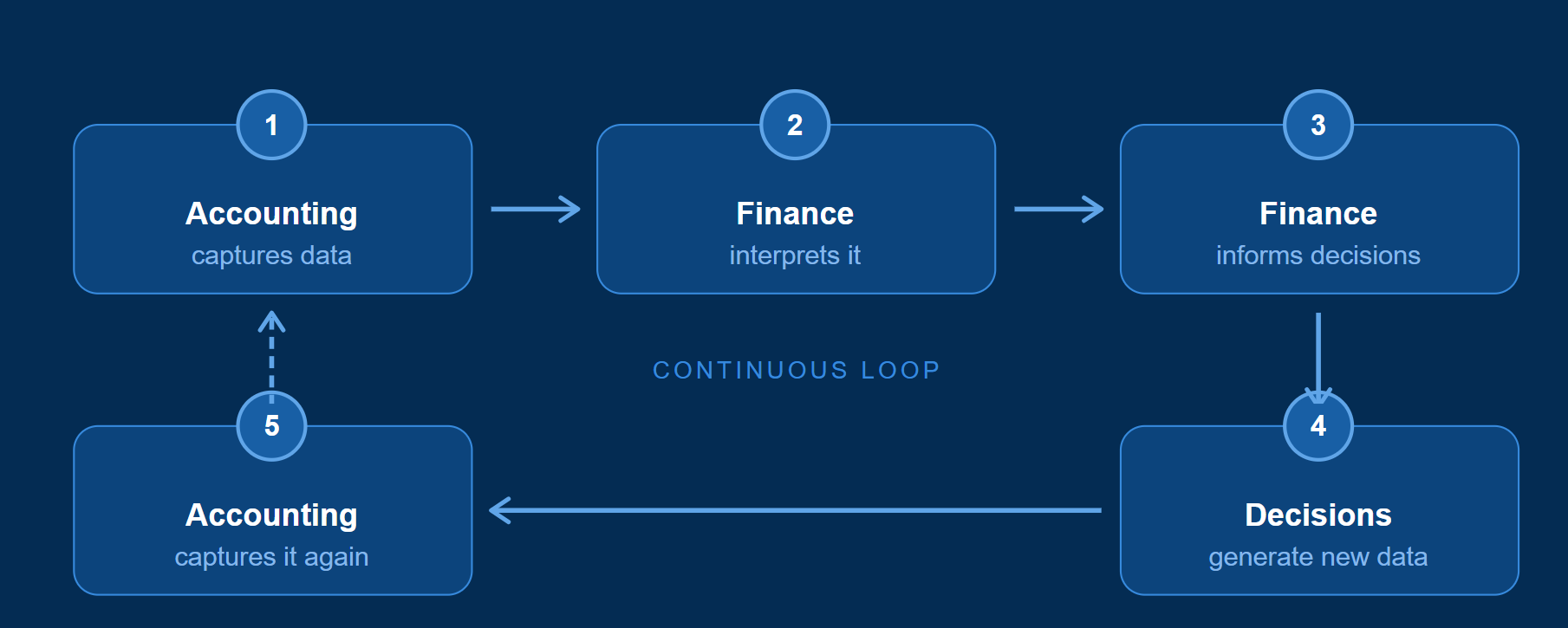
You can't build solid financial projections on sloppy books. A CFO working off misclassified expenses or timing errors isn't forecasting — they're guessing with extra steps. Conversely, a company that runs a tight accounting shop but never invests in finance capabilities ends up with perfectly accurate records of a business that drifted off course.
Strong businesses treat accounting as the foundation and finance as the structure built on top. This is why working capital management requires both: accounting to accurately track receivables and payables, and finance to optimize the cycle strategically.
Most org charts in companies reflect accounting and finance as separate but closely connected departments.
Accounting roles tend to sit within the controllership function:
Finance roles typically sit under the CFO or FP&A umbrella:
Sometimes in smaller companies one person might wear both accounting and finance hats.
Which is fine…
Until it isn’t.
When a business starts making real capital allocation decisions, entering new markets, or exploring outside investment, having a single person split between compliance and strategy is a meaningful risk.
That's exactly where a Fractional CFO can step in — providing senior-level finance leadership without requiring a full-time hire.
What is a Fractional CFO?
They're the senior finance leader you need at your current stage without the six-figure salary commitment that comes with a full-time hire.
When you're growing through a new phase, managing a critical transition, or finally ready to stop flying blind on the strategic side, a Fractional CFO can become a right hand person who is able to bridge the gaps by working with your existing accounting team, building the finance function around it, and making sure your biggest decisions are backed by real analysis.
Accounting vs Finance Careers: Which Is Right for You?
Typically, the following individuals find themselves more suited to accountancy careers than anything else:
For finance careers, on the other hand, we are talking about individuals that:
Many professionals are a mixture of both.
As for credentials, accountants typically pursue their CPA, while finance professionals seek the MBA, CFA, or FP&A designation. Both disciplines offer lucrative careers, although finance executives in growing enterprises can earn even more given that the CFO
Here's the angle that doesn't get enough attention.
When CEOs and founders conflate accounting and finance, the consequences show up in very specific, very painful ways:
Poor forecasting. If you're relying on your accountant to tell you what revenue will look like in Q3, you're asking the wrong person. Accountants record actuals; they're not trained to build the models and assumptions that drive a reliable rolling forecast.
Compliance risk. Conversely, if your finance team is too focused on growth models and nobody is minding the regulatory requirements, you're accumulating risk. Tax deadlines, audit readiness, and GAAP compliance don't wait for the strategic planning cycle.
Inefficient capital allocation. Knowing your numbers isn't the same as knowing what to do with them. Companies that lack a true finance function often make capital decisions based on gut instinct and cash balance — not unit economics, scenario modeling, or burn rate analysis.
And can we be honest? The businesses that do this best aren't necessarily the ones with the biggest teams. They're the ones where leadership actually understands how accounting and finance serve different purposes — and staffs accordingly. Leaders who understand both functions make better strategic decisions. Full stop.
Think of it this way: if you're reacting, you probably need accounting. If you're planning, you probably need finance.
Call on accounting when:
Call on finance when:
Many growing companies hit a point where their accounting is solid — but they're flying blind on the finance side. That gap is exactly what Interim CFO support or fractional finance leadership is built to address.
While we're here — let's close the loop on bookkeeping, because it often gets lumped into this conversation incorrectly.
Bookkeeping is the entry-level layer — recording individual transactions in a software platform. Critically important, but it's raw data, not analysis.
Accounting structures that data, ensures compliance, and produces formal financial outputs.
Finance takes those outputs and drives decisions.
Bookkeeping → Accounting → Finance
Each layer depends on the one below it. A finance leader making capital decisions based on faulty bookkeeping entries is building a skyscraper on sand.
Accounting and finance are both indispensable — the distinction isn't about which matters more, it's about understanding they serve completely different purposes.
Accounting is the foundation: accurate, historical, rule-driven. It tells you where you've been and ensures you're operating within the guardrails. Finance is the engine: analytical, forward-looking, judgment-driven. It translates data into decisions that shape the company's future.
The companies that outperform tend to have both working in concert — with someone at the senior level who bridges them and connects every financial metric back to business strategy. That integration is what separates well-run businesses from reactive ones.
Let's cut through all the technical complexity and think about what really matters.
For businesses in growth mode — whether you're scaling a services firm, preparing for investment, or navigating a complex transition — having the accounting-finance distinction blurred at the leadership level is a meaningful liability.
We see it constantly: controllers getting pulled into strategic planning work they're not equipped for, finance folks who don't have reliable accounting data to model from, and CEOs trying to bridge both functions themselves while running a company.
Here's what we know from working with businesses across industries and growth stages: the organizations that thrive aren't the ones with the biggest finance teams. They're the ones with the right expertise at the right moment.
Whether that means interim CFO support during a high-stakes transition, a fractional CFO partnership for ongoing strategic finance leadership, or CFO coaching to develop the finance capability already inside your organization — the goal is the same. Less time guessing, more time growing.
Ready to make sure your business has the right financial leadership in place?
The difference between knowing about accounting and finance and actually leveraging both effectively usually comes down to having the right expertise at the table. Let's talk about what that looks like for your organization.
Accounting records and reports historical financial transactions — what happened. Finance analyzes that data to guide future decisions — what should happen next. Both are essential, but they serve fundamentally different functions.
Neither is objectively harder — they require different strengths. Accounting demands precision and mastery of rules. Finance requires analytical thinking, comfort with ambiguity, and the ability to model complex scenarios. Many professionals develop competency in both over time.
Yes, and it's a common transition. Accountants have a strong foundation in financial data, which is valuable in finance roles. The shift typically involves building stronger modeling and forecasting skills — often through an MBA, CFA, or FP&A experience.
Both offer competitive compensation at senior levels. Senior finance roles — CFO, VP of Finance, FP&A Director — often command a premium in high-growth companies. Senior accounting leadership like a Controller is also well-compensated, particularly in larger organizations.
Without question. Accounting maintains accurate records and compliance. Finance drives growth decisions and strategic planning. As companies scale, the cost of not having both functions in place compounds quickly.


.svg)

.svg)