
Learn the SaaS metrics that matter most to executives and investors, including CAC, LTV, churn, and the Rule of 40.
Learn the SaaS metrics that matter most to executives and investors, including CAC, LTV, churn, and the Rule of 40.


Here’s a scenario that happens more often than anyone cares to admit:
SaaS founder comes into a meeting with investors, pitch deck, slide, and an impressive ARR number. Investor nods. SaaS founder says, “Okay, what’s your customer acquisition cost payback period?”
Silence.
Not the good kind.
A SaaS founder knows ARR inside and out.
They’ve been touting it from the rooftops for two years. But the deeper metrics, the ones that really reveal the health of a business, well, those just didn’t make it beyond the ARR number.
SaaS metrics aren’t just alphabet soup for data teams to fight over in a Slack channel.
They’re the operating system of a subscription business.
All major business decisions, from pricing to hiring to Go-to-Market spend, depend on them. Executives who understand SaaS metrics build scaling businesses.
Executives who don’t, well, they’re just growing into trouble, usually without even realizing it.
Here’s a guide to the SaaS metrics that really matter: what they measure, how to calculate them, what ‘good’ looks like at different stages, and finally, how to use data to drive actual business decisions.
SaaS metrics, as a whole, are important numbers that measure the health, efficiency, and growth of a software business, with a focus on recurring business models unique to SaaS, as opposed to traditional business models that focus on one-time sales.
These important numbers measure the health, efficiency, and growth of a software business.
What makes SaaS interesting, as well as risky, is that the business generates money from a customer over their lifetime.
With a focus on recurring business models unique to SaaS these metrics are opposed to traditional business models that focus on one-time sales.
SaaS metrics exist to surface those dynamics before they become crises. They answer the questions that matter:
Post-2022, the SaaS industry has had its moment of truth. The world of "grow at all costs" has met its match with rising interest rates, tighter capital markets, and investors who now care a whole lot more about profitability, not just growth.
And 2026 appears to be no different. According to a recent Forbes article, a single product launch by an AI company in February wiped out $300 billion of market value across the SaaS industry in a matter of days, not because of an earnings miss, but because investors now seem to be wondering if the old SaaS economics even apply in an AI-native world. SaaS is a world that has moved from sticky by default to prove it every quarter.
The ones that did well were the ones that understood their unit economics.
That's not an accident. SaaS metrics map to three things that matter to any company at any stage of growth:
Investors judge software-as-a-service companies with a very particular financial filter. A high LTV: CAC, low churn, and growing NRR tell a completely different story from a company that loses money to acquire customers it cannot retain. Metrics are the language of any serious fundraising conversation.
Financial models built on solid SaaS metrics are significantly more accurate than any forecast made by intuition or guesswork. When you know your average contract value, your expansion rate, and your churn, you can project your revenue with precision, not wishful thinking.
Metrics show you exactly where your growth is stuck. When your CAC is growing faster than your LTV, something is broken in your sales or marketing machine. When your churn suddenly accelerates in month six, something is broken in your product or onboarding flow. The metrics show you where to look, and even better, where to stop guessing.
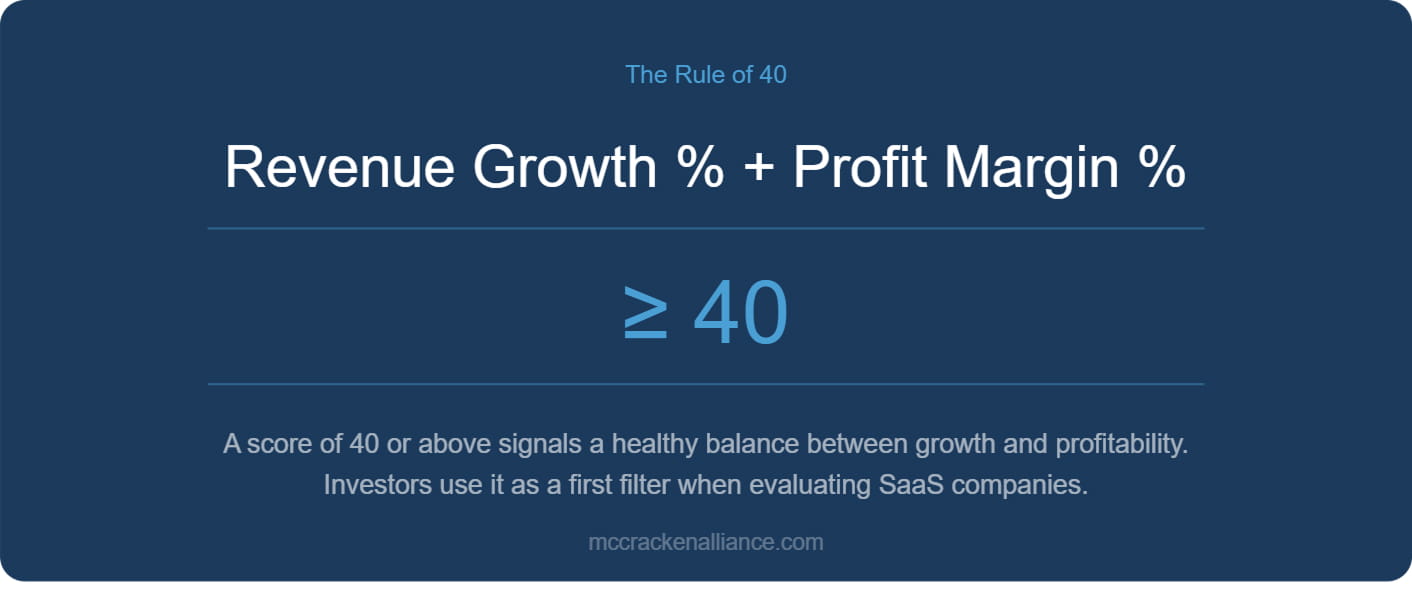
There is one metric that ties all this together, and it is the Rule of 40. The rule is this: the revenue growth rate of a software-as-a-service company plus the profit margin should be at least 40. It is now widely used to judge the balance between growth and profitability, and is one of the first things sophisticated investors look at.
Monthly Recurring Revenue (MRR): MRR is the normalized monthly recurring revenue across all active subscriptions. This is the pulse of the business. This is something that should be monitored in real time by the executive leadership.
Annual Recurring Revenue (ARR): ARR = MRR x 12. This is the yearly version. This is mostly used to appease investors and for company valuation. This is the number in the pitch deck. MRR is the number that tells you if the pitch deck is true.
Customer Acquisition Cost (CAC) CAC measures what it actually costs to acquire a new customer — fully loaded. That means sales salaries, marketing spend, tools, events, and overhead.
CAC = Total Sales & Marketing Spend ÷ New Customers Acquired
Many companies underestimate CAC by 30–40% because they leave out the fully-loaded costs. That's the kind of blind spot that makes unit economics look better than they are until it doesn't.
Customer Lifetime Value (LTV) LTV is the total revenue a customer generates over the life of their relationship with you, adjusted for margin.
LTV = Average Revenue per Customer × Gross Margin % × Average Customer Lifetime
High LTV means customers are valuable and sticky. Low LTV usually points to churn problems, weak expansion revenue, or both — and both are worth investigating immediately.
Churn Rate The churn rate is the proportion of customers (or revenue) lost over a set period. Customer churn and revenue churn, though related, are not quite the same.
Monthly Churn Rate = Customers Lost in Period ÷ Customers at Start of Period × 100
Annual benchmarks vary by segment. SMB-focused SaaS typically targets under 7% annually. Enterprise-focused businesses operate with tighter expectations — often under 5%.
Net Revenue Retention (NRR) NRR is perhaps the most powerful metric in the SaaS industry. It shows if existing customers are growing, shrinking, or churning, all in one single metric.
NRR = (Starting MRR + Expansion − Contraction − Churn) ÷ Starting MRR × 100
An NRR above 100% means the business is growing revenue from existing customers alone, before adding a single new account. Best-in-class SaaS companies routinely show NRR above 110–120%. That's the metric that makes investors actually lean forward.
CAC Payback Period This measures how long it takes to recover the cost of acquiring a customer through their subscription revenue.
CAC Payback = CAC ÷ (MRR per Customer × Gross Margin %)
Under 12 months is strong. Under 18 months is acceptable. Over 24 months means the business is funding growth with expensive, long-cycle capital — a structural problem, not just an efficiency issue.
Rule of 40 Rule of 40 = Revenue Growth Rate % + EBITDA Margin %
A score above 40 signals a healthy balance between growth and profitability. It's particularly useful as SaaS companies scale, and the tradeoffs between reinvestment and margin become harder to navigate without a clear framework.
The LTV:CAC ratio deserves a callout here.
A 3:1 ratio is the standard benchmark — for every dollar spent acquiring a customer, the business should expect to recover three. Below 1:1 means the company is destroying value with every new logo it closes. No amount of growth rate can paper over that math for long.
Metrics on their own are just numbers. The value comes from using them as a connected system — not isolated KPIs that each live in a different department's spreadsheet.
Where the LTV is low compared to the CAC, the pricing model is something worth looking at. Many SaaS companies start low to get adoption high, only to realize they cannot raise prices without causing churn. Analyzing the LTV by customer cohorts also allows you to determine if pricing strategies are working or simply causing churn with a delay.
The CAC payback period also determines how aggressively to hire sales staff. Where the payback is already 18 months, hiring two enterprise salespeople with 12-month ramp periods is both a hiring and a cash flow consideration. This is how company leaders avoid the hire-panic-restructure cycle. Scenario planning around headcount decisions is how leadership teams avoid the hire-panic-restructure cycle.
The efficiency of lead sources varies considerably. Where the CAC is broken down by acquisition source, it often reveals that one or two channels are doing all the heavy lifting, with others quietly draining the marketing budget. This is exactly the kind of analysis that separates good revenue teams from expensive ones.
Companies with NRR below 100% are pouring water into a leaky bucket. Every growth strategy needs stress-testing against the retention picture. Sometimes the best growth lever isn't more acquisition — it's improving the customer success motion to capture expansion revenue already hiding in the existing base.
Tracking the metrics that matter to high-growth companies creates the foundation for this kind of integrated thinking. SaaS metrics don't operate in isolation — they connect directly to capital allocation, burn rate management, and every major resourcing conversation the executive team has.
Numbers without context are just numbers. Here's what industry benchmarks look like across key SaaS metrics, informed by data from OpenView Partners and Bessemer Venture Partners:
Benchmarks differ significantly depending upon the company type, customer type, and even the go-to-market motion. An SMB-focused product with a high-velocity self-serve motion has vastly different churn expectations than an enterprise product with multi-year contracts and significant implementation requirements.
The idea isn’t to hit all of these benchmarks. It’s to identify where we’re missing out, what’s causing it, and what this means for the entire business model. Benchmarking without diagnosis is simply data tourism.
A SaaS metrics dashboard is only useful if it shows the right things at the right level of detail. Most executive dashboards either include too much (every metric anyone ever tracked) or too little (ARR and nothing else).
The core metrics that belong at the executive level:
Tools like Tableau, Looker, or even a SaaS analytics starter like ChartMogul or Baremetrics can help automate a lot of this data work. However, the tool is not as important as just looking at the metrics and relating them to actual decisions.
But let’s get real for a second….
Most SaaS businesses that make less than $20M ARR don’t have the financial setup in place to reliably churn out this work.
The data is somewhere—maybe in Stripe, maybe in Salesforce, maybe in a spreadsheet somewhere.
It’s just not being wired together in a clear, actionable way. This is not a tech problem. This is a financial leadership problem.
This is a financial leadership problem, and this is precisely the type of thing a fractional CFO is designed to solve without having to hire a full-time person. A good financial leader will show up, will figure out where your data is, will build a reporting system that ties all that data together, and will ensure that leadership is looking at the right numbers on a consistent basis.
The SaaS Industtry landscape has changed in so many ways over the last few years. The window for growing fast, figuring out profitability later, has contracted significantly. Capital costs are higher, investors are more woke, and the hottest valuations are for companies with real growth, not just a high top line with a story.
Rule of 40 went from a nice-to-have to essentially a requirement in the context of fundraising conversations for Series B+ rounds and beyond. Net Revenue Retention is the clearest indicator of product-market fit, even ahead of growth rate as a standalone factor.
AI-driven forecasting is making the bar higher for execs in terms of understanding their business. When you can forecast scenarios with greater and greater accuracy, you're at a disadvantage if you're relying on rough estimates.
The leaders in this environment are the ones who have made SaaS metrics literacy a leadership requirement, not just an analyst requirement a few levels down in the organization.
SaaS metrics feel overwhelming when you're looking at eight or ten interconnected KPIs, all pointing to different levers.
That complexity is real.
But the numbers are only half the challenge.
The harder half is building the operational infrastructure to produce them reliably, interpret them accurately, and act on them quickly enough to matter.
The good news?
Some of these roadblocks are absolutely predictable and ultimately fixable:
Where the data is available in theory, but there is a lack of real-time systems that make this data available. Revenue data is available in Stripe, customer data is available in Salesforce, but no one has integrated this data into a system that is available for leaders to make decisions on.
It’s one thing to know that your NRR is 98%, but another thing entirely to understand why your NRR is 98% and which customers are pulling this number down.
The big drop-off is where a metric translates into a decision. It’s not enough to make a GTM reallocation based on CAC trends, but rather have financial leadership – not just numbers that no one is looking at end-to-end.
This is exactly where experienced CFO leadership changes how SaaS companies operate. Whether through interim CFO support during a fundraise or growth inflection, fractional CFO partnership for ongoing financial strategy, or targeted finance training that builds internal capability, the right financial guidance moves SaaS metrics from reporting exercise to strategic advantage.
The companies that scale with confidence aren't the ones with the most impressive ARR slide. They're the ones that understand every number behind it.
Ready to build a SaaS metrics framework that actually drives decisions?
The difference between tracking metrics and leveraging them often comes down to having the right financial expertise at the right moment. Let's talk about how McCracken Alliance can help you get there.
The key SaaS metrics that every executive needs to track include ARR, MRR, CAC, LTV, churn rate, NRR, CAC payback period, and Rule of 40. Collectively, these metrics provide a comprehensive understanding of the business's revenue performance, customer metrics, and growth potential.
A good LTV to CAC ratio should be around 3:1. However, companies that are exceptional in their performance have LTV to CAC ratios of 5:1 or even higher. On the other hand, companies with ratios lower than 1:1 are essentially throwing money down the drain, as no matter what their growth rate may be, it cannot overcome the fact that they are spending more money to acquire a customer than they will ever see in return.
The churn rate can be found by dividing the number of customers lost within a specific period of time by the total number of customers at the start of that period. Once this number has been found, it needs to be multiplied by 100.
The Rule of 40 is a rule that states that a SaaS company’s revenue growth rate + profit margin (EBITDA or free cash flow) should equal at least 40. It's a common benchmark for evaluating the balance between growth investment and profitability, and it's become a standard metric in fundraising conversations at growth-stage companies.
Because SaaS metrics reveal whether a company’s growth is efficient, durable, and scalable.
Investors often use metrics like NRR, CAC, payback, and the Rule 40 in order to assess whether a business can compound value over time.


.svg)

.svg)